
A disability inclusion policy only works when it names the specific barriers people face and assigns real responsibility for removing them. A statement of values with no owner, no process, and no review date changes nothing on the ground. This guide walks through the exact sections your policy should contain, what belongs in each one, and how to ground the document so it holds up when someone tests it. By the end you will have a usable skeleton to draft or upgrade a policy for a workplace, school, nonprofit, or public program.
What a disability inclusion policy actually is (and what it’s for)
Disability inclusion is the systematic process of identifying and removing the barriers that stop people with disabilities from participating fully in everyday life. According to the CDC’s disability inclusion strategies, inclusion means people with disabilities have the same opportunities to take part in society as everyone else, which requires actively finding and dismantling obstacles rather than waiting for individuals to ask for exceptions.
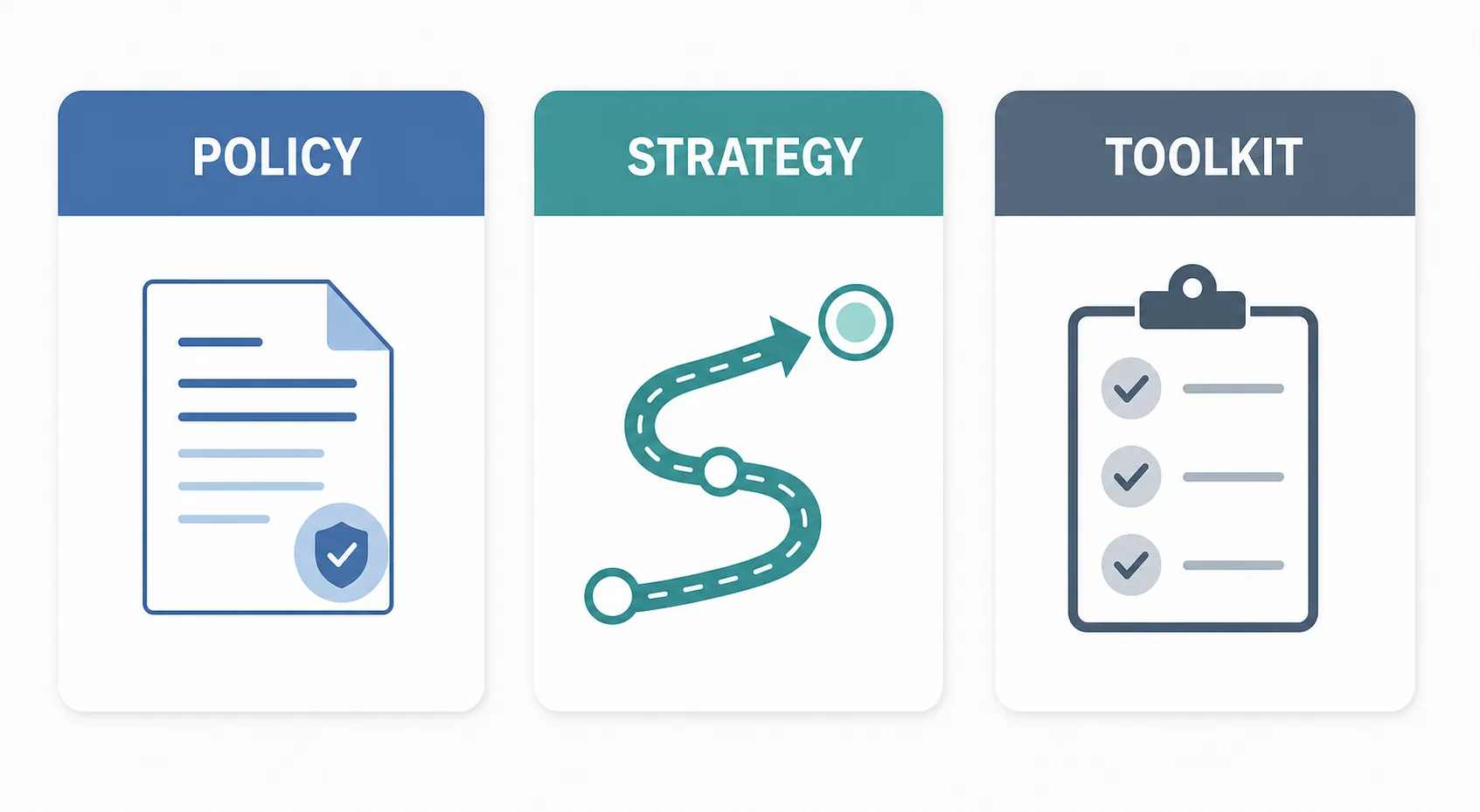
It helps to separate three things that often get blurred. A policy is the governing document: the formal commitment, the rules, and the accountability structure your organization agrees to be held to. A strategy is how you sequence the work over time. A toolkit is the collection of templates, checklists, and guidance people use to execute. This article is about the policy, the anchor document everything else references. Get it right and the strategy and tools have something firm to hang on.
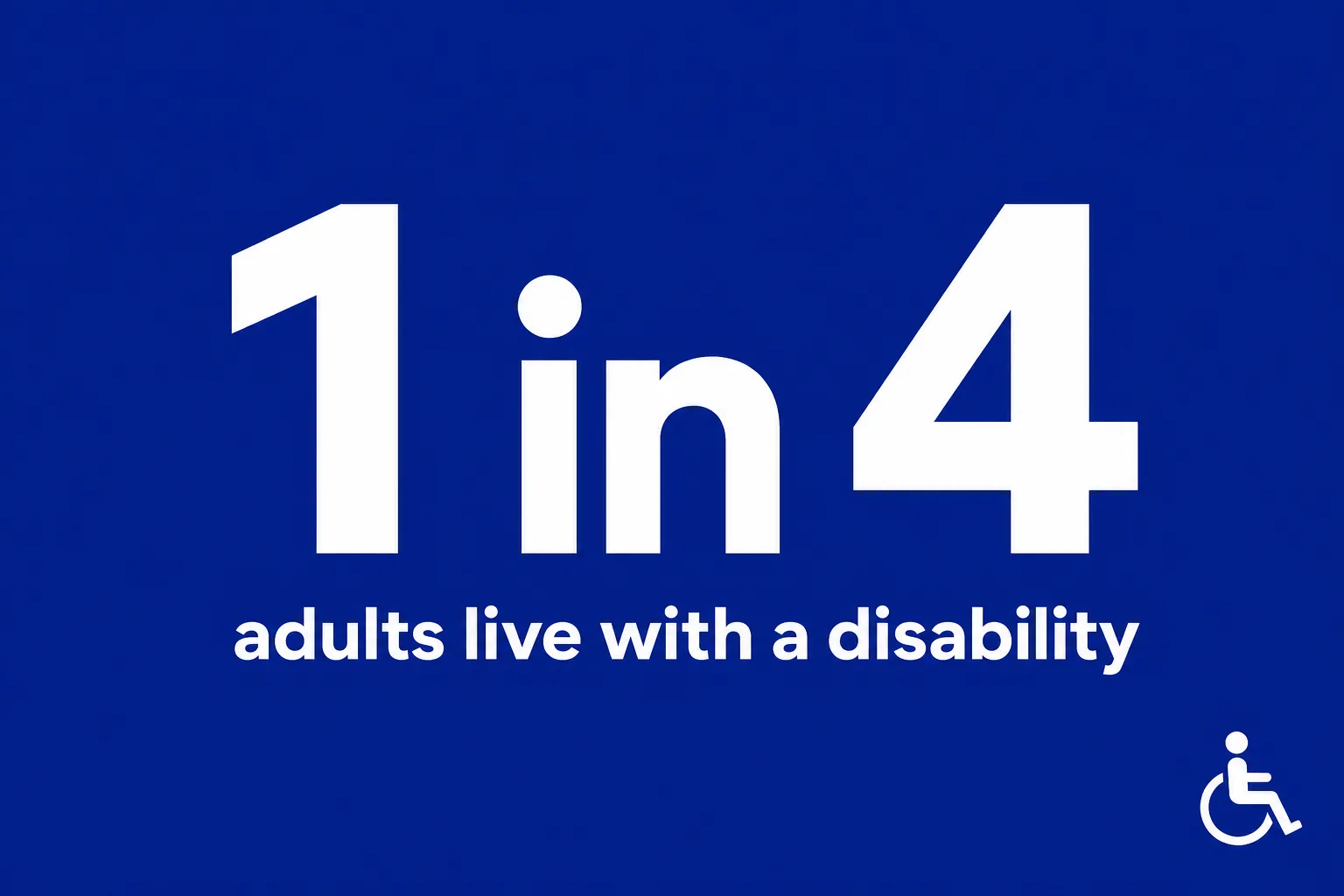
The importance of disability inclusion runs deeper than politeness or optics. Roughly one in four adults lives with a disability, which makes inclusion a mainstream concern for any organization that serves the public or employs people. CDC data in Disability Impacts All of Us shows roughly one in four adults lives with a disability, which makes inclusion a mainstream concern for any organization that serves the public or employs people. A clear definition at the top of your policy sets the standard everything below it must meet.
Why a formal policy matters
Inclusion is an equity and public-health issue, not a compliance afterthought. A written policy is what converts good intentions into accountable practice, because it creates something you can point to, measure against, and enforce.
The public-health framing is worth stating plainly in your document. A call to action for more disability-inclusive health policy argues that people with disabilities have historically been left out of health systems and data, which drives avoidable disparities in outcomes. When your policy treats inclusion as a determinant of health and wellbeing, you make a stronger, more defensible case than one built on reputation alone.
Grounding the case in real numbers helps too. Rather than inventing statistics, point readers to a reputable source such as the Syracuse University disability statistics research guide, which compiles prevalence and employment data from federal surveys. Building disability awareness on verified facts, not assumptions, keeps your policy credible and keeps your training accurate.
A formal policy also protects your organization. It signals to staff, funders, and the people you serve that inclusion is a standing commitment with structure behind it, not a project that fades when the person who championed it moves on.
What to include in a disability inclusion policy: the core sections
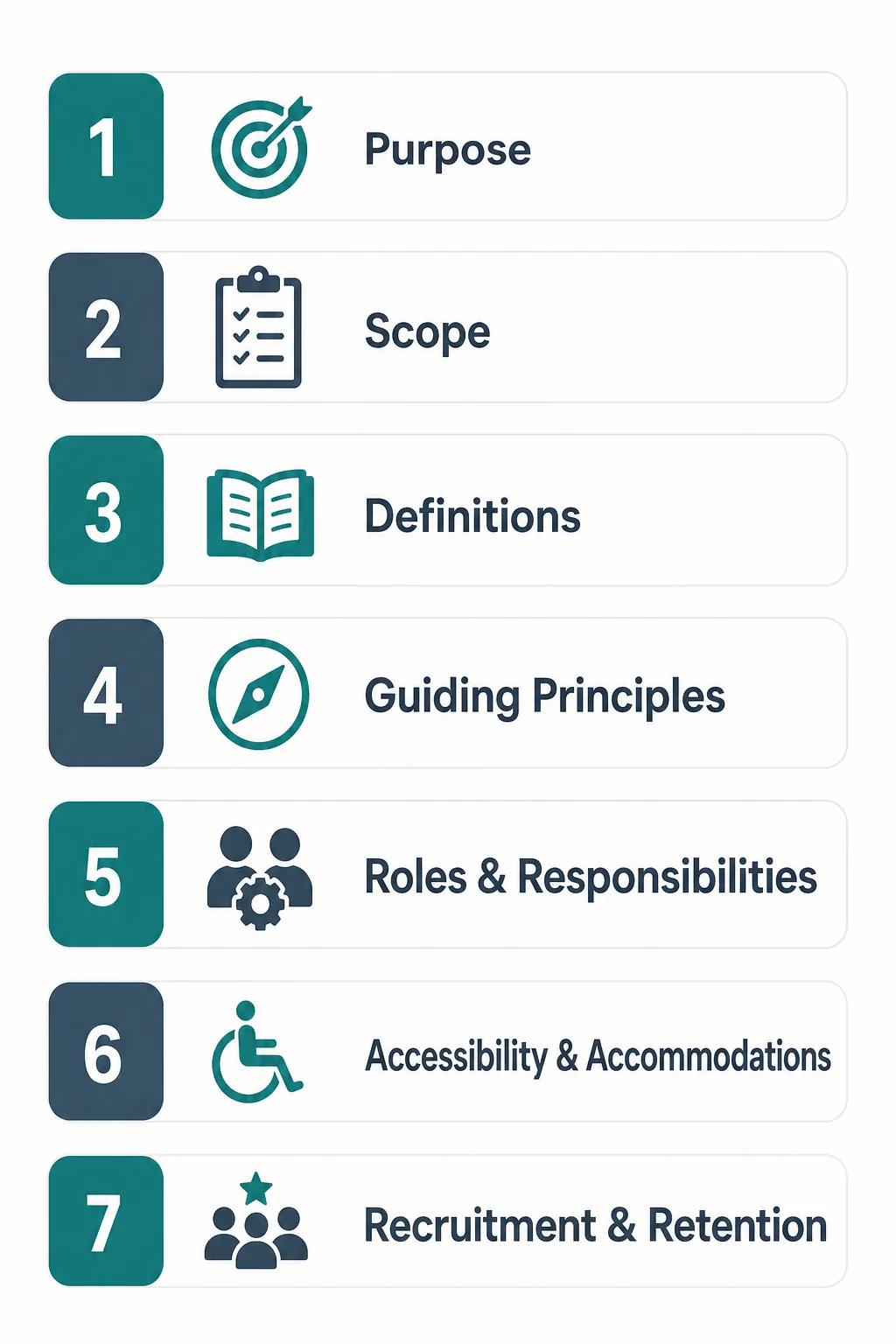
Here is the document skeleton. Each heading below is a section your policy should contain, with a note on what goes inside it. Adapt the language to your setting, but keep the components: reviewers and auditors look for these.
Purpose and commitment statement
Open with why the policy exists and what it commits the organization to. This is where leadership endorsement belongs, in plain language, signed off at the top. A commitment stated by the board or executive carries weight that a mid-level memo never will.
Scope
Spell out who and what the policy covers. That usually means employees, volunteers, board members, contractors, and program participants, across both physical and digital spaces. Ambiguous scope is where accountability leaks out, so name the groups and settings explicitly.
Definitions
Define the key terms so everyone reads the policy the same way: disability, ableism, accessibility, reasonable accommodation, and the difference between equity and equality. Equality gives everyone the same thing; equity gives people what they each need to reach the same outcome. Defining ableism, the assumption that non-disabled ways of doing things are the default, names the bias the policy exists to counter.
Guiding principles
State the values that shape decisions when the rules do not give a clear answer. Common principles include dignity, universal design, and “nothing about us without us,” the commitment that people with disabilities help shape the decisions that affect them rather than having solutions designed for them.
Roles and responsibilities
Name who owns implementation, who holds decision rights, and how accountability flows. A policy with no named owner is a wish. Assign a role or office responsible for the policy, define what managers are accountable for, and make clear where a stalled request escalates.
A policy with no named owner is a wish.
Accessibility standards and accommodations process
Set the standards for physical access, digital access (reference the Web Content Accessibility Guidelines for websites and documents), and communication. Then describe the accommodations process step by step: how a person requests an adjustment, who reviews it, the expected timeline, and how privacy is protected. A clear, low-friction process is what turns the commitment into daily reality.
Recruitment, retention, and participation
Cover inclusive hiring and inclusive program access: accessible job postings and applications, interview accommodations, and practices that keep people supported once they are in the door. Evidence from the Burton Blatt Institute review of inclusive policies and practices shows that inclusion works best when it runs across the full employment cycle, not just at the point of hire.
Training and awareness
Commit to ongoing disability-awareness education for staff and leadership, and say how often it happens. One-time onboarding is not enough; attitudes and skills need refreshing as teams and tools change.
Monitoring, evaluation, and review
Define how you will know the policy is working: the metrics you track, the review cadence (annual is a common baseline), and the feedback loops that let people report what is and is not working. Set the date the policy gets revisited so it does not quietly expire. Choosing the right numbers is its own exercise, and we unpack what DEI success actually looks like in a separate guide.
Grievance and reporting mechanism
Provide a safe, clearly described channel for raising barriers or discrimination, with protection from retaliation. People will only surface problems if the route to do so feels safe and actually leads somewhere.
If you want a structure you can adapt rather than build from a blank page, our disability-inclusive policy toolkit provides a framework you can model, which also answers the common search for a disability inclusion policy PDF you can download and shape to your context.
The 4 elements of inclusion your policy should reflect
People often ask what the four elements of inclusion are. A practical way to frame them is access, participation, supports, and belonging with accountability. Each maps directly to sections you have already drafted.
| Element | What it means | Where it lives in the policy |
|---|---|---|
| Access | People can get in the door, physically, digitally, and procedurally. | Your accessibility standards |
| Participation | People can take part meaningfully once inside, not just be present. | Recruitment, retention, and program access |
| Supports | The individualized accommodations and adjustments that make access and participation real. | Your accommodations process |
| Belonging with accountability | People are valued members and someone is answerable for keeping it that way. | Roles, monitoring, and grievance sections working together |
The federal policy statement on inclusion of children with disabilities in early childhood programs builds on this access, participation, and supports framework, which has become a widely used reference across sectors well beyond early childhood.
Disability barriers your policy needs to name and remove
A policy is only as strong as the barriers it targets. Vague language about “promoting inclusion” gives no one anything to act on. Name the barrier types with concrete examples, then tie each to what the policy should require.
| Barrier type | Example | What the policy clause should require |
|---|---|---|
| Attitudinal | Assuming a disabled candidate can’t handle a role; talking to a companion instead of the person | Mandatory disability-awareness training; direct, respectful communication standards |
| Physical / architectural | Steps with no ramp; narrow doorways; inaccessible restrooms | Facility accessibility standards and a remediation timeline for existing sites |
| Communication | PDFs a screen reader can’t parse; no captions; jargon-heavy forms | Digital accessibility standard (WCAG); plain-language and alternative-format requirements |
| Policy / systemic | Rigid schedules or leave rules that penalize disability-related needs | Flexible-arrangement provisions; review of internal rules for hidden exclusion |
| Transportation | Meetings only reachable by car; no accessible transit options | Accessible-location requirements; remote-participation option for every meeting |
Most policies list barriers in the abstract. Mapping each barrier to a specific clause is what makes yours actionable, because it tells the reader not just what the problem is but what the document obligates the organization to do about it.
From policy to community access and integration
Inclusion does not stop at the office door. Community access means people with disabilities can use the same public spaces, services, and opportunities as everyone else, on the same terms. Community integration is the outcome that access makes possible.
Which of these are examples of community integration? Living independently in a regular home rather than a segregated facility; working in an integrated setting alongside non-disabled colleagues, not a separate program; shopping, banking, worshiping, and recreating in the same places as the rest of the community; and voting and taking part in civic life. The common thread is ordinary participation in mainstream settings, not parallel systems.
Progress on this front is real but uneven. The National Council on Disability’s 2025 progress report tracks how community living and integration have advanced and where gaps persist, which is useful context if your policy sets community-facing goals. If your organization wants to turn a policy into visible community action, there are ways to support inclusive community access that extend the commitment beyond internal operations.
Examples of inclusive policies in practice
What are some examples of inclusive policies? Here are concrete, ready-to-adopt practices you can write directly into your document as clauses:
- Flexible work arrangements as a standing option, so schedule and location adjustments are routine rather than exceptional.
- Accessible-first communications: every document, website, and email meets an accessibility standard by default.
- Inclusive procurement: accessibility is a required criterion when buying software, tools, or services.
- Universal design in facilities: spaces and products are designed to work for the widest range of people from the start, reducing the need for retrofits.
- Accessible meeting standards: captions, agendas shared in advance, a remote option, and accessible venues as the default for every meeting.
These sit on top of a legal backdrop worth referencing briefly rather than lecturing on. In the United States, Section 504 of the Rehabilitation Act, the Americans with Disabilities Act, and the accessibility provisions of the Affordable Care Act set the floor. Universal design, highlighted in the CDC strategies cited earlier, is the design philosophy that lets you build above that floor instead of just meeting it. Your policy’s job is to translate those principles into clauses your organization will actually follow.
How to write and roll out your policy
Drafting the document is one step; getting it adopted and used is another. Before the pilot stage, someone with signing authority has to agree to fund it, and securing approval from the top has a sequence of its own. A short, workable process looks like this:
- Consult people with disabilities first. Co-design with people who have lived experience of the barriers you are addressing. This is the step most organizations shortchange, and it is the one that separates a policy that reflects reality from one that guesses at it.
- Draft the sections above, using clear, plain language.
- Pilot and review with the people affected and with the staff who will implement it, then revise. Municipal teams can also see how to align city policy with the CRPD in a seven-step sequence written for city hall rather than a single department.
- Publish the final policy in accessible formats and communicate it widely.
- Train staff and leadership on what the policy requires and how the processes work.
- Schedule the review so the policy stays current as your organization and technology change.
Implementation is where most policies stall, so line up support in advance. Our accessibility resources can help teams put the standards into practice rather than leaving the document on a shelf.
Frequently asked questions
What should a disability inclusion policy include at minimum?
What are the 4 elements of inclusion?
What are some examples of inclusive policies?
Which of these are examples of community integration?
Is there a disability inclusion policy PDF template we can use?
A strong disability inclusion policy does two things well: it names the real barriers people face, and it assigns real accountability for removing them. Everything in this guide serves those two goals. When you are ready to draft or upgrade yours, the toolkit and accessibility resources above give you a structure and support to build on.