
A low-floor bus with a working ramp is useless if it stops at a corner with no curb cut. A station with a new elevator is a closed station on the days that elevator is out of service.
Accessibility fails at the seams, which is why a system can buy exactly the right equipment and still strand the riders it bought that equipment for.
This guide covers what it takes to make a transit system genuinely usable: the physical infrastructure, the vehicles, the information, and the operating policies, plus the maintenance and measurement that hold all four together. It is primarily for transit agencies, city planners, and elected officials, while also giving riders and advocates a framework for evaluating plans and reporting barriers.
The answer to how to make public transport accessible is to connect step-free routes, accessible vehicles, clear passenger information, fair fares, trained staff, reliable maintenance, and accountability from the rider’s front door to the final destination.
Accessible Public Transport Checklist
A practical accessibility plan should cover the full journey:
- Accessible routes to stops and stations, including continuous paths, curb cuts, safe crossings, and accessible temporary routes.
- Step-free boarding through level boarding, ramps, lifts, bridge plates, or another workable solution suited to the mode.
- Vehicles with usable securement areas, reachable controls, priority seating, and enough circulation space.
- Passenger information in audio, visual, tactile, plain-language, and digital formats, including accessible passenger information during disruptions.
- Fares and service policies that do not make an accessible route unaffordable or impractical.
- Staff trained to provide respectful assistance and manage accessibility equipment and disruptions.
- Maintenance, outage communication, and emergency plans that keep accessible paths usable.
- Co-design, journey-based audits, measurable owners, and public accountability.
What Makes Public Transport Accessible?
Accessible public transport should be available when and where people need it, usable independently where possible, supported by reliable assistance when requested, affordable, and dignified. A system can meet several criteria and still exclude riders when one critical link fails.
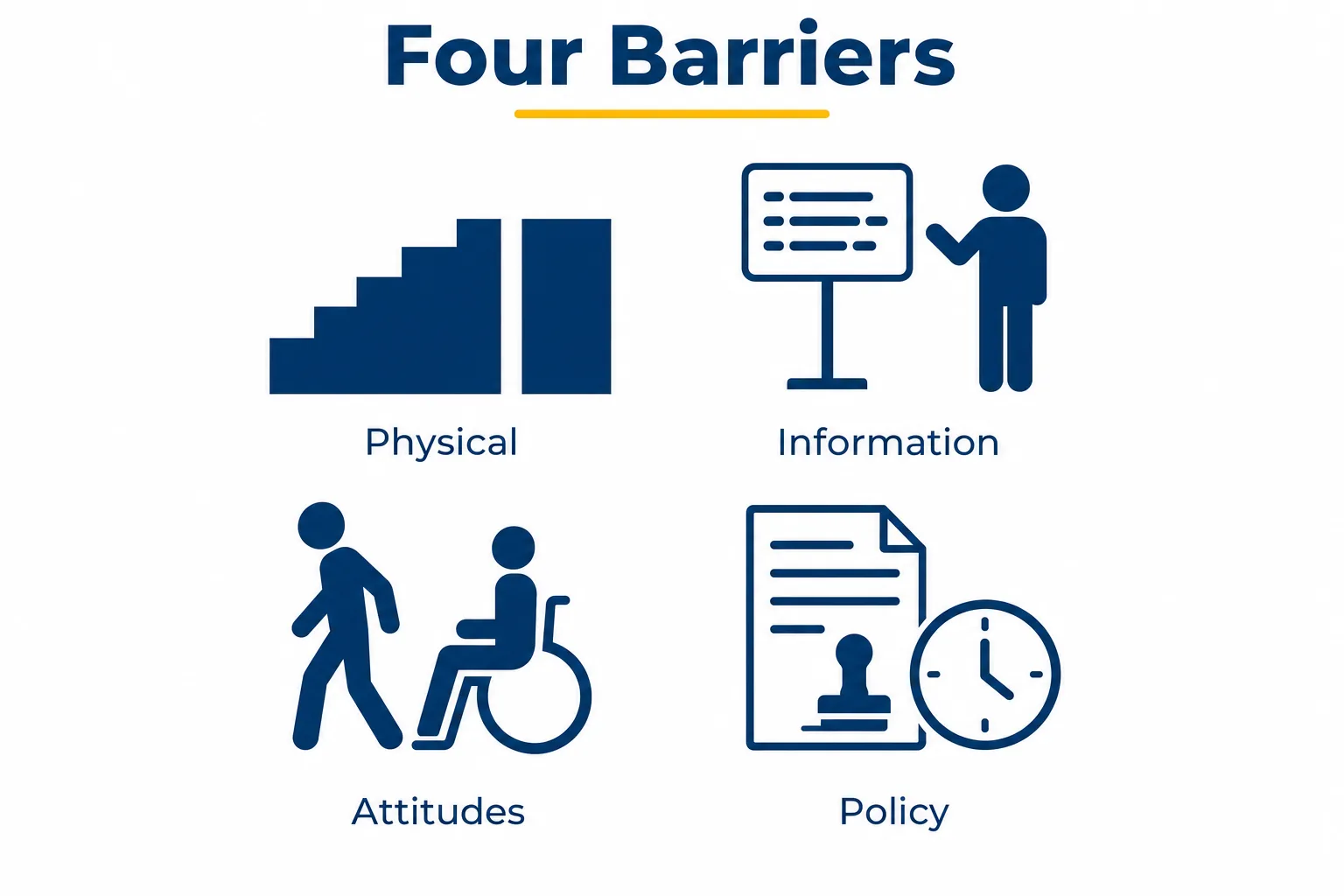
Barriers to public transportation fall into four recurring categories, and they make a useful working framework:
- Physical barriers: steps, gaps, missing elevators, broken sidewalks, unusable stops.
- Informational barriers: signage nobody can read, announcements nobody can hear, apps that fight screen readers.
- Attitudinal barriers: operators who skip a waiting wheelchair user, or address a companion instead of the rider.
- Policy and institutional barriers: fare rules, service spans, paratransit eligibility processes, budget priorities.
Treat accessibility as a system property rather than a feature bolted onto one vehicle or one station. Universal design, designing for the widest plausible range of users from the first drawing, can reduce later retrofits, such as reopening a station to add a lift shaft.
Who accessible transit serves (far more than wheelchair users)
Designing for one user group produces narrow fixes. The real ridership includes:
- Wheelchair and mobility device users, and ambulatory riders with limited stamina who need seating more than they need ramps.
- Blind and low-vision riders who depend on tactile surfaces, audio announcements, and predictable layouts.
- Deaf and hard-of-hearing riders who need every audio announcement mirrored visually.
- Riders with cognitive, intellectual, and psychosocial disabilities, for whom a legible, predictable system is the accessibility feature.
- Older adults aging in place, pregnant riders, parents with strollers, and anyone hauling groceries or luggage.
- Low-income riders, for whom fare levels and transfer rules decide whether the network is usable at all.
- Riders with limited literacy or limited fluency in the local language, who rely on pictograms and audio.
Accessible transportation for persons with disabilities serves a specific access need while also improving the system for many other riders.
Design the whole journey, not just the vehicle
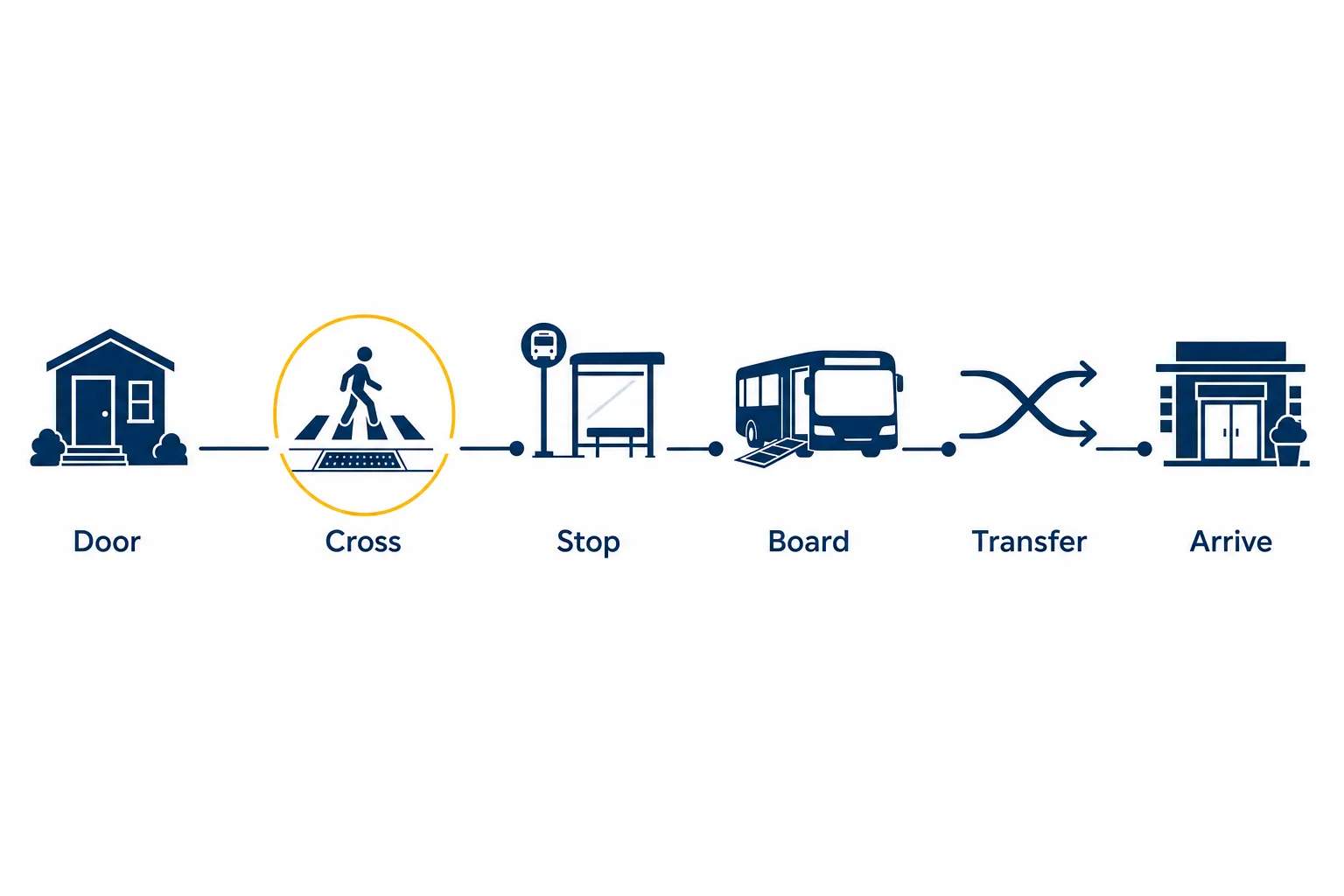
A trip starts at somebody’s front door, not at the platform edge. Agencies audit assets: stations, buses, elevators. Riders experience chains: sidewalk, crossing, stop, boarding, ride, transfer, alighting, final approach. One broken link fails the entire trip, and the broken link is often not owned by the transit agency at all.
Map trips end to end and audit them that way. This surfaces first- and last-mile problems that asset inventories miss: missing curb cuts, crossing signals timed for walking speeds some riders cannot maintain, cars parked across the ramp, snow piled at the stop, and construction detours with no accessible alternative. Because transport access begins in public space, include sidewalks, crossings, curb ramps, and temporary works in the audit.
This requires coordination across agencies that may own different parts of the journey. Sidewalks, crossings, and snow clearance usually sit with a public works or streets department, while vehicles and stations sit with the transit agency. Establish a standing joint process with named owners, a shared defect log, and a route-based priority list, or the handoff will keep swallowing complaints. The UK Department for Transport’s Inclusive Mobility guidance is a useful pedestrian-and-transport reference; adapt it to local law, design standards, and ownership arrangements.
Fix the physical infrastructure
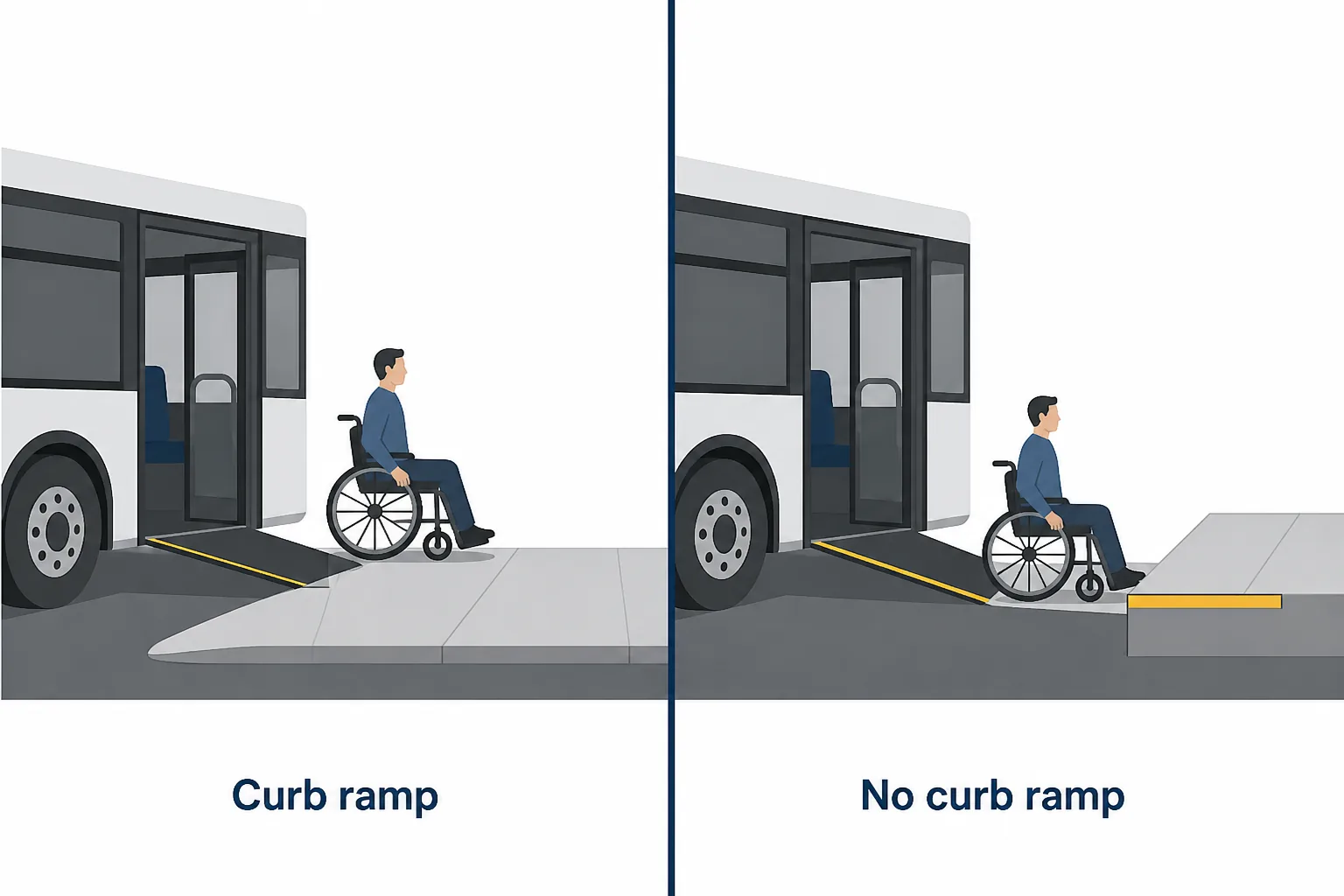
Step-free access should continue from the public footway to the boarding point and through the station or stop. For accessible bus stops and rail stations, review the approach, boarding interface, seating, signage, lighting, and backup route as one system.
- Step-free at every station, with redundancy. Elevators alone are a single point of failure. Ramps, second elevators at high-volume stations, and clearly signed alternate routes keep access alive when equipment goes down.
- Close the gap at the platform. The horizontal and vertical gap between platform and vehicle floor is what actually stops independent boarding. Level boarding, platform humps, bridge plates, or gap fillers solve it. Precision docking helps on bus rapid transit.
- Tactile warning surfaces along platform edges, and tactile guide paths through large or confusing stations.
- High-contrast edge markings, glare-controlled lighting, and consistent handrail placement. Consistency matters as much as specification: riders learn one pattern and expect it everywhere.
- Seating and shelter at outdoor stops. For riders who cannot stand for ten minutes, a bench is the difference between a usable route and an unusable one.
- Accessible restrooms, water, and rest points at major interchanges, especially where transfers involve long walks.
When retrofit funds are limited, prioritize by ridership, transfer volume, and proximity to hospitals, clinics, dialysis centers, schools, social-service offices, and senior housing. These destinations can make an inaccessible station especially consequential for appointments and daily activities.
Design and Procure Accessible Vehicles
Procurement decisions shape accessibility for the life of the fleet, so write clear, rider-tested performance requirements rather than relying on a generic compliance statement.
Low-floor buses with kneeling capability and deployable ramps should be the fleet default, not a subfleet. Wheelchair securement areas need to fit larger power chairs and scooters, not just the compact manual chair that appears in the drawings. Rear-facing or independently operable securement lets many riders board and settle without waiting on the operator, which cuts dwell time and preserves dignity at the same time.
Circulation matters as much as the securement bay. Wide doorways, generous turning space, and stanchion layouts that do not trap a mobility device determine whether a rider can actually reach the space built for them. Priority and flexible seating serve seniors, pregnant riders, and disabled riders, and dedicated stroller space keeps those groups from competing for the same square meter.
Onboard, every stop announcement should exist in both audio and visual form, and stop-request buttons should be reachable from a seated position at multiple heights. Write these as performance requirements with acceptance testing and warranty coverage. A specification that says “compliant” buys compliance. A specification that says a rider using a large power chair must be able to board, position, and secure independently within a defined time gives the agency a testable accessibility requirement.
Make Passenger Information Accessible
People cannot use service they cannot find or understand.
- One signage system across the whole network. High-contrast, sans-serif type sized for actual viewing distance, consistent placement, and pictograms supporting text.
- Real-time audio and visual announcements for next stops, arrivals, and disruptions, both onboard and in stations. Disruption information deserves the same accessibility standard as routine service information.
- Braille and tactile signage at decision points, plus audible beacons at station entrances that are hard to locate.
- Plain language and multiple languages. Do not assume fluency or high literacy. Short sentences and clear icons help everyone under time pressure.
- Publish accessibility status as open data. An elevator and escalator outage feed can help riders and trip-planning tools route around failures.
- Trip planners with step-free routing filters, accessible-entrance data, and journey estimates that use realistic walking speeds rather than an assumed brisk pace.
Digital accessibility is transit accessibility
Apps, ticketing kiosks, and websites are now part of the boarding process, which makes them part of the accessible path of travel. They must work with screen readers, voice control, switch access, and text scaling. Use the W3C Web Accessibility Initiative’s accessibility fundamentals as a starting reference, then test with people who use assistive technology daily and pay them for that testing.
Fare payment and accessible ticketing also deserve specific attention. A digital-only or card-only fare system can exclude unbanked riders, riders without smartphones, and some older adults. Keep a cash or retail top-up path. On kiosk hardware, check reachable screen height, tactile keypads, headphone jacks for audio output, and contrast that survives direct sunlight.
Service policies that decide who actually rides
Capital projects get the attention, but operating policy often decides who can use the system.
Frequency is an accessibility feature.
Long headways can be especially difficult for riders who cannot stand at a stop, walk easily to an alternative route, or absorb a missed connection. Span of service matters for shift workers, caregivers, and anyone with a medical appointment outside peak hours.
Stop spacing is a real trade-off rather than a solved question. Wider spacing speeds the route for everyone onboard and lengthens the walk for riders with limited mobility. Resolve it corridor by corridor, with attention to which destinations sit between the remaining stops.
Fare structure decides affordability on multi-leg trips. If an accessible route requires two transfers because the direct route has an inaccessible station, transfer-free policies or daily fare capping can keep the detour from costing the rider extra. Plan disruptions at the same time: when an elevator or station goes out, an accessible shuttle bridge and proactive messaging should be ready for the closure.
Plan for Disruptions and Emergencies
A closure or emergency should trigger an accessibility plan, not a separate afterthought. Prepare accessible replacement vehicles, alternative step-free routes, accessible temporary stops, multichannel alerts, evacuation procedures, and real-time equipment status. Assign one team responsibility for confirming the alternative path and updating riders until normal service returns.
Paratransit, demand-responsive service, and travel training
Paratransit complements an accessible fixed-route network; it serves eligible riders who cannot use fixed-route service under the applicable rules. In the United States, the Federal Transit Administration’s complementary-paratransit guidance and 49 CFR Part 37 paratransit rules provide the regulatory framework. Confirm current corridor, eligibility, and service-criteria requirements before designing a program.
Common service problems include booking windows that require committing a day ahead, wide pickup windows that leave riders waiting outside, trip denials, missed return trips, and no same-day availability. Track these as service-quality metrics and report them publicly where data and privacy practices allow.
Microtransit zones and subsidized accessible taxi or ride-hail programs can fill gaps, but only if the contract requires an adequate supply of wheelchair-accessible vehicles with comparable wait times. Travel training, meaning hands-on coaching on planning and riding a fixed route, can support independent use when a rider wants or benefits from it. In some rural and small-city contexts, demand-responsive service may be the network rather than a supplement, which raises the bar for how well it needs to be run.
Train Staff to Deliver Accessible Service
Attitudinal barriers quietly undo capital investment. An operator who does not stop, does not deploy the ramp, deploys it while sighing, or talks to a companion instead of the rider makes a fully compliant bus unusable in practice.
Good operator training is concrete: ask before assisting and follow the rider’s answer, allow boarding time without visible impatience, announce stops even when the automated system fails, and know how to work the ramp and securement correctly on a cold morning. Dispatchers and control-center staff need their own training on accessible detours and disruption messaging, since they are the ones improvising when something breaks.
Build the curriculum with disabled trainers who bring lived experience. The Foundation’s learning modules on inclusive and accessible cities can support general learning, while operators still need role-specific practice. Pair it with accountability: complaint channels that are themselves accessible (phone, text, web, and in person), published resolution timelines, and pattern analysis so repeat problems on a specific route reach a supervisor.
Related readingSteps to Make a Company More AccessibleRead the guide →Co-design with disabled riders from the first sketch
Consultation that begins after the design is finished has limited power to change the result. Effective co-design includes disabled riders at concept stage, at mockup stage, and again after opening, with enough influence to change decisions.
Standing accessibility advisory committees work when they have budget influence, early sight of capital plans, and voting seats rather than an advisory footnote. Run physical mockup walkthroughs and pilot boarding tests with a genuine range of devices, including large power chairs, scooters, walkers, service animals, and strollers, before mass procurement locks the design in. Pay participants for their expertise and time, the same as any other consultant.
Disability-led advocacy and inclusive-cities practice treat lived experience as a design input that shapes the project from the beginning. Earlier feedback gives the team a chance to address barriers before design decisions are final.
Maintain Accessibility After Implementation
An out-of-service elevator can make an otherwise accessible station unusable for some riders, so equipment status and repair response belong in the accessibility plan.
Set and publish uptime targets for elevators and escalators, report performance against them, and fund redundancy where a single failure isolates a station. Put ramps, lifts, kneeling systems, and announcement systems on preventive maintenance schedules. Define the operating response when accessibility equipment fails, including when a vehicle must be removed from service and how riders are informed. Tactile paving, lighting, and signage belong in the maintenance cycle too, since worn surfaces and burned-out lighting fail quietly.
Seasonal and temporary conditions deserve the same discipline. Snow, leaves, and construction detours can close an accessible path even when the permanent design meets standards. Assign responsibility, set clearance timelines for stops and station approaches, and require accessible temporary routes where local permitting rules allow.
Measure it: audits, indicators, and accountability
A count of compliant stations is a poor proxy, because it counts assets rather than trips. Better accessibility indicators describe what riders actually experience:
- Share of the population within a step-free walk of frequent service.
- Accessibility equipment uptime, reported by station and by month.
- Paratransit on-time performance, denial rate, and average booking lead time.
- Complaint volume by category and time to resolution.
- Share of stop announcements functioning on audited trips.
Connect Each Barrier to an Owner
Responsibilities vary by jurisdiction, so confirm ownership locally. A practical transit-agency accountability plan can connect each barrier to a likely owner and a measure:
| Barrier | Likely owner | Example measure |
|---|---|---|
| Sidewalk and curb-ramp gaps | Municipality or public works department | Share of audited routes with continuous access |
| Vehicle boarding failures | Transit operator | Failed boarding incidents and equipment uptime |
| Missing announcements | Transit agency or contractor | Share of audited trips with working announcements |
| Paratransit delays | Transit agency or provider | On-time performance, denials, and booking lead time |
| Unresolved complaints | Accessibility or customer-service team | Resolution time and repeat-issue rate |
Run journey-based audits with mixed-ability rider panels traveling real routes, and repeat them annually so trends are visible. Publish results openly, including limitations in the data, so decision-makers can track progress. Use accessibility and transport equity outcomes when scoring capital programs, so equity is considered alongside travel-time and state-of-good-repair goals.
Legal frameworks, funding, and procurement levers
Legal standards set a floor; agencies should also measure whether riders can use the service reliably, independently where possible, and with dignity.
In the United States, the Americans with Disabilities Act and Department of Transportation regulations include requirements for accessible vehicles, facilities, and complementary paratransit in applicable fixed-route systems. Internationally, the UN Convention on the Rights of Persons with Disabilities, Article 9 treats accessibility, including transportation access, as a human rights issue; exact duties depend on each jurisdiction’s laws and accessibility standards. The Foundation’s Cities for All program offers a related inclusive urban development perspective that connects city action with rights-based and other international frameworks.
For a practical policy framework, audit checklist, and examples, teams can use the Foundation’s Inclusive Policy Toolkit, then have local legal and accessibility specialists validate final requirements.
For cross-jurisdiction comparison, the ITF/OECD good-practice guide on improving transport accessibility can help agencies compare approaches; adapt any recommendation to local governance, law, and available data.
Accessibility upgrades are often easier to deliver when bundled into scheduled work. Station renewal, state-of-good-repair programs, repaving, and signal replacement can align the construction window and budget line. Use procurement specifications, grant conditions, and mandatory design-review sign-off by accessibility staff as enforcement points, because those are moments when a decision is still reversible.
A practical sequence for agencies with limited budget
1. Run a journey audit on the highest-ridership corridors with disabled riders. A journey audit can reveal barriers that an asset inventory misses. 2. Fix the cheap, high-impact items first. Stop-level seating and shelter, signage corrections, snow clearance protocols, operator training, and repairs to announcement systems already installed. 3. Prioritize step-free access at transfer hubs and at stations serving health care, education, and employment, using local access and ridership data to set the order. 4. Write accessibility into every vehicle and construction procurement so new assets are tested against the required access criteria. That helps prevent the backlog from growing while you address existing barriers. 5. Publish a dated accessibility roadmap with named owners and report progress annually, including what slipped and why.
What riders and advocates can do
A documented pattern is easier for an agency to investigate than an isolated report. When something fails, record the route, direction, stop, date, time, and vehicle number where possible, then file it through the official channel and keep a copy.
Show up where capital budgets are decided, which usually means board meetings, capital program comment periods, and long-range plan hearings rather than the customer service line. Join an accessibility advisory committee if one exists, and if it is purely advisory, push for voting representation and early sight of designs.
Build coalitions. Senior groups, parent groups, labor organizations, and low-income rider coalitions want many of the same things: frequency, seating, shelter, working elevators, and affordable transfers. A broader coalition can strengthen the investment case. Keep pushing for open data on elevator status and paratransit performance, because public reporting makes recurring failures easier to identify and address.
How the Victor Pineda Foundation Can Support Implementation
The Victor Pineda Foundation’s advisory services include inclusive city-planning frameworks, accessibility audits and roadmaps, policy development, training, and measurement. Organizations that need support moving from an assessment to an implementation roadmap can request an advisory consultation. For additional frameworks, checklists, and policy examples, explore the Foundation’s resources on disability inclusion and accessible cities.
FAQs About Public Transport Accessibility
Frequently asked questions
How can public transport be made accessible for people with disabilities?
What makes public transport accessible?
What are the main barriers to accessible public transport?
What accessibility features should buses and trains have?
How can agencies measure public transport accessibility?
Does paratransit replace accessible fixed-route transit?
How can riders report an accessibility barrier?
What laws or standards apply to accessible public transport?
Accessible transit is a design decision, made repeatedly
Infrastructure, vehicles, information, policy, maintenance, and measurement work together. Every procurement, station renewal, service change, and budget cycle is an opportunity to test whether riders can use the system with independence and dignity.
Rider feedback helps turn standards into working elevators, deployed ramps, and announced stops. Treat accessibility as an ongoing operating standard, then publish progress and address gaps as they appear.