
You might not have a word for it yet. You just notice that you work harder than everyone around you to do the same job, or that the office was clearly built for a version of you that isn’t quite you. Meetings move too fast, the tools fight you, requests for a small adjustment get met with a raised eyebrow. If that sounds familiar, you are not imagining it, and you are not the problem. Work through an employer accessibility checklist to turn these gut feelings into documented gaps.
Here is the thing most “toxic workplace” articles miss: an inaccessible workplace and a toxic workplace are usually the same workplace. Fixes hold only when a written disability inclusion policy names who is responsible for them. Physical, digital, and cultural barriers feed dysfunction, and dysfunction hides behind those barriers. This is a plain-language checklist of the signs, what each one actually means, and how to protect yourself, without anyone telling you to just quit.
What “accessible” actually means at work (and why it’s a health signal)
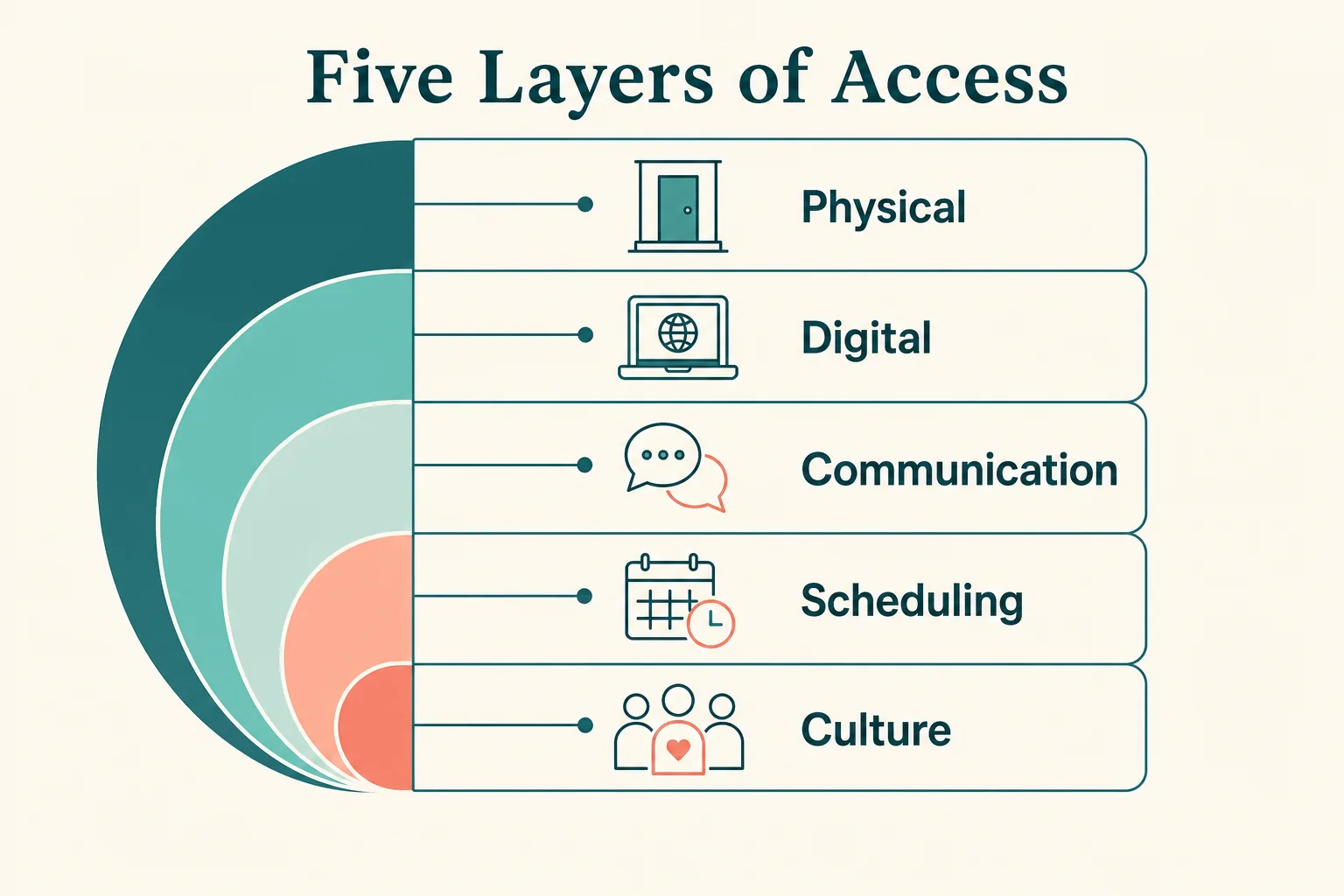
Accessibility is not just ramps and elevators. A genuinely accessible workplace works across five layers: the physical space, the digital tools, the way people communicate, the flexibility in scheduling, and the culture and attitudes that surround all of it. A ramp at the door means little if every internal document is unreadable with a screen reader, or if asking for a quieter workspace gets you labeled “difficult.”
Why does this double as a health check? Because accessibility gaps reveal how a company treats anyone who deviates from the imagined “default” employee. The same rigidity that shuts out a disabled worker also punishes the new parent, the person managing a chronic illness, the introvert, the caregiver, and eventually most people who stay long enough. Accessibility is the early warning sign for a dysfunctional culture. That matters for your health, not just your comfort. The American Psychological Association reports that toxic workplaces leave employees stressed, sick, and scared, with measurable effects on mental and physical wellbeing. When a workplace excludes by design, the cost lands on your body.
Signs your workplace is not accessible: the checklist
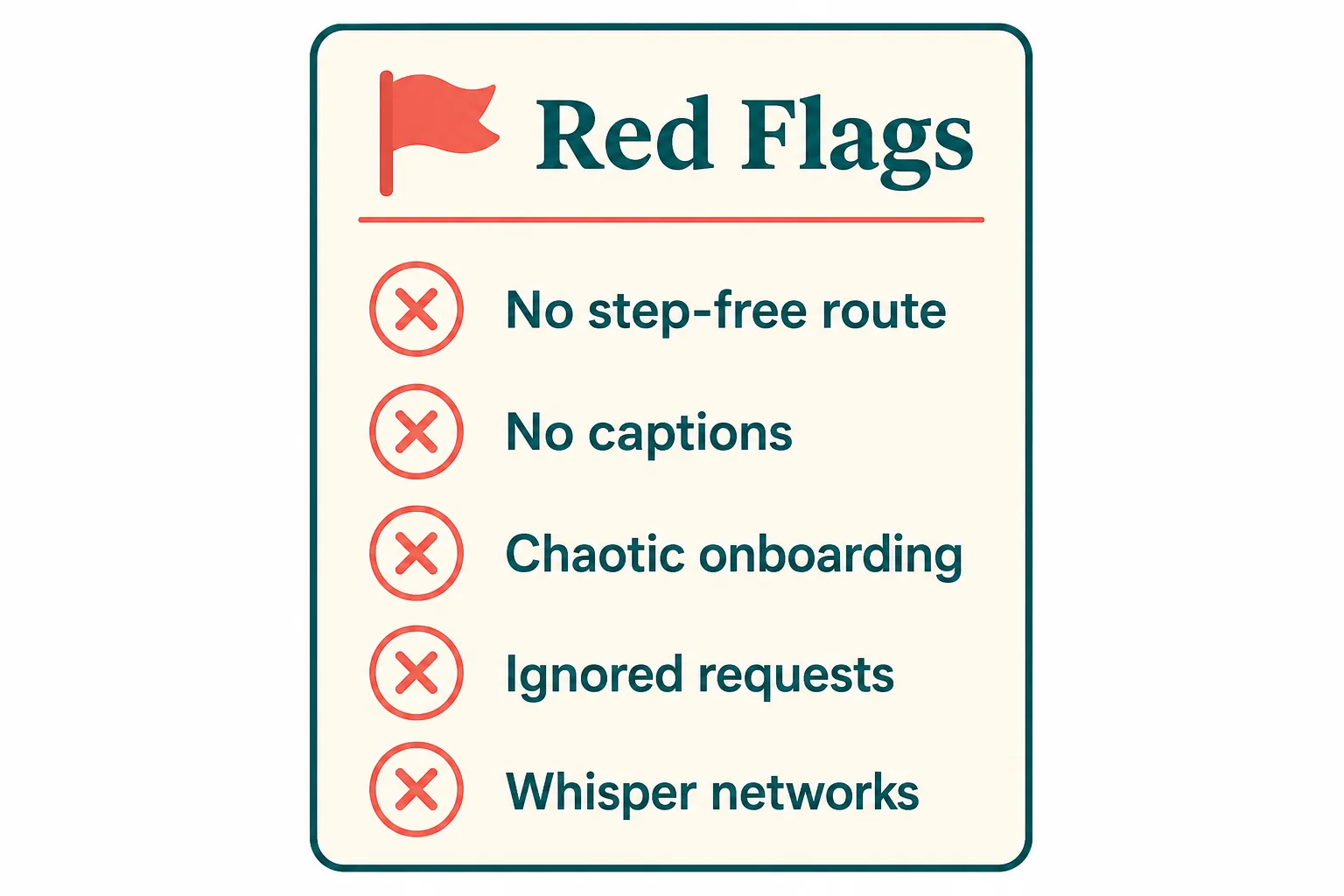
Use this as a scan, not a scorecard. One item on a bad week is normal. A cluster of them, repeating, is a pattern, and a pattern is a culture.
Physical and logistical barriers
- No step-free route to the spaces people actually use, or an “accessible” entrance that is really the loading dock.
- Restrooms, kitchens, or meeting rooms that a wheelchair user, a cane user, or someone with a mobility aid cannot realistically use.
- No quiet or low-stimulation space anywhere, so anyone who needs to decompress has nowhere to go.
- Parking, transit, and “just pop in early” assumptions that quietly exclude people who commute differently.
The tell isn’t only that the barriers exist. It’s the response when you name them. When a reasonable adjustment gets treated as a personal favor the company is generously granting, rather than a normal part of running a workplace, that attitude will show up everywhere else too.
Digital and communication barriers
- Documents, spreadsheets, and software that break with screen readers, keyboard navigation, or zoom.
- Video meetings with no captions and no agenda, where you’re expected to absorb everything in real time.
- Information that only travels one way: verbal-only announcements, or decisions buried in a chat thread nobody can search later.
These are the barriers that get defended with “it’s just how we’ve always done it.” That phrase is doing a lot of work. It usually means the workplace excludes people by default and has decided not to look at it.
The “figure it out yourself” onboarding
Chaotic or nonexistent onboarding is one of the clearest early signals, and it’s easy to miss because you’re too busy drowning to name it. If your first weeks were a scramble of guessing passwords, hunting for the person who knows the thing, and learning unwritten rules by breaking them, that’s not a rough start. It’s a company that doesn’t invest in its people. This is also the plainest example of what lack of support in the workplace looks like: no clear expectations, no map, and no one accountable for helping you land.
Accommodations met with friction, delay, or silence
- Requests that vanish into “we’ll look into it” and never resurface.
- Adjustments stuck permanently “under review” while you keep struggling.
- A quiet sense that asking at all put a mark against your name.
In the United States, this isn’t just bad manners. Under the Americans with Disabilities Act, qualified employees have the right to reasonable accommodation, and employers are required to engage in a good-faith interactive process. The U.S. Equal Employment Opportunity Commission lays out these employment rights for individuals with a disability. Stonewalling a legitimate request is a signal about the whole culture, not a one-off scheduling problem.
Cultural and attitudinal signs
- Whisper networks and hushed conversations that stop when certain people walk in.
- People who avoid eye contact with a particular manager, or steer around a specific team.
- Cliques and in-groups where the same handful of people get the good projects, the real information, and the benefit of the doubt.
- Gaslighting, where you’re told the thing you witnessed didn’t happen or wasn’t a big deal.
- Vague, moving-target feedback that can never be satisfied.
- Overcommitment framed as loyalty, and exploitation framed as “we’re a family here.”
This is the cluster people mean when they list the seven signs of a toxic work environment or describe an abusive workplace. Individually each has a plausible excuse. Together they describe a place where fear, not trust, keeps things running.
Signs you personally are not valued
- Your ideas get ignored in the room, then repeated by someone else and praised.
- There’s no growth path, no honest conversation about your future, no development.
- Credit for your work flows upward and away from you.
- Your wellbeing is treated as a productivity input, mentioned only when it dips.
If you’ve searched for signs you are not valued at work, you already know the feeling: present but interchangeable. A healthy workplace can name what you specifically contribute. An unhealthy one only notices you when you stop producing.
The 4 unprofessional behaviors that quietly signal a broken culture
People often ask what the four unprofessional behaviors in the workplace are. There’s no official list, but four patterns show up again and again in dysfunctional cultures, and they’re worth naming plainly:
| Behavior | What it looks like |
|---|---|
| Bullying and intimidation | Public dressing-downs, threats disguised as jokes, using status to make people small. |
| Dishonesty and gossip | Talking about colleagues instead of to them, shifting stories, taking credit and dodging blame. |
| Harassment and discrimination | Treating people differently based on who they are, including how a workplace treats disability, and letting it slide when a favored person does it. |
| Chronic disrespect of boundaries and time | After-hours demands with no notice, meetings that ignore your calendar, adjustments and requests brushed aside. |
What makes these corrosive isn’t a single incident. It’s when they go unaddressed and become the water everyone swims in. Berkeley Executive Education notes that a toxic environment is often defined less by dramatic events than by patterns leadership tolerates. If unprofessional behavior has no cost for the people doing it, that’s your answer about the culture.
What are the stumbling blocks that keep good people stuck?
Another common question: what stumbling blocks actually exist at work, the ones that trip up capable people who are trying hard? The usual suspects:
- Unclear expectations, so you’re graded against a standard nobody will state out loud.
- Inaccessible processes, where the way work gets done assumes abilities, tools, or availability you don’t have.
- Favoritism and nepotism, where relationships outrank results.
- Zero accountability, so problems get named but never owned.
- No psychological safety, meaning it isn’t safe to ask a question, admit a mistake, or push back.
Notice how tightly these connect back to accessibility. The same rigidity that blocks a disabled worker, the refusal to adjust how things are done, blocks everyone’s growth. When a workplace can only run one way, anyone who needs it to run differently gets stuck. The research backs this up: a peer-reviewed study on how a toxic workplace environment erodes employee wellbeing and performance shows it drains the very people the organization needs most. Stumbling blocks aren’t personal failings. They’re design choices.
Stumbling blocks aren’t personal failings. They’re design choices.
“Am I in a toxic work environment?” A quick self-check
Skip the gimmicky quiz. Just sit with these prompts honestly. Answer yes or no.
- Do you feel physically tense on Sunday evening, dreading Monday?
- Have you stopped raising ideas because you expect them to be ignored or stolen?
- Do you censor normal needs, an adjustment, a day off, a question, because asking feels risky?
- Are there people you actively route around to protect yourself?
- Do you leave most days more depleted than the work alone would explain?
- Has someone told you a thing you clearly experienced “wasn’t what happened”?
- Do the same few people get grace while everyone else gets scrutiny?
A few scattered yeses might just describe a hard stretch. A steady wall of them describes an environment. Remember the rule: one bad day is a bad day. A repeating pattern is a culture, and cultures rarely fix themselves without pressure.
How to protect yourself in a toxic or inaccessible workplace
Most articles are long on symptoms and short on what to do. Here is the part that actually protects you.
Document everything. Keep a private, dated record: what you asked for, when, who you asked, and what they said or didn’t say. Save emails to a personal note. Patterns are persuasive; memory is not. If a request or an incident ever matters formally, contemporaneous notes are your strongest evidence.
Put requests in writing and know your rights. Verbal accommodation requests are easy to lose and easy to deny. A short, factual email creates a record and often prompts a more serious response. Learn what protections apply where you work, whether that’s the ADA in the US or the equivalent in your country, so you can name the process the employer is supposed to follow.
Build allies and outside support. Isolation is how toxic environments keep their grip. Find the colleagues who see it too, a trusted contact in HR if one genuinely exists, a mentor outside the company, a union or employee resource group, or a professional who can advise you. You don’t have to carry this alone or figure it out in your own head.
Protect your health, deliberately. Guard your off-hours. Take the leave you’re entitled to. Get support for the stress before it becomes something heavier. Your job is not worth your health, and the workplaces that imply otherwise are exactly the ones this article is about.
Tell a fixable gap from a place you need to leave. Some workplaces are simply behind and will move once you name the problem and show them the path. Others have heard it all and chosen not to change. The difference usually reveals itself when you ask directly and watch what happens next: good-faith effort, or more delay and more blame. Believe what you see.
When barriers are the problem, not you
Here’s the reframe worth holding onto. An enormous number of “performance” and “culture fit” problems are really access problems that the workplace refuses to name. You’re labeled slow when the tools are unusable. You’re called disengaged when meetings are impossible to follow. You’re seen as high-maintenance for needing what would let you do your best work. The barrier gets rebranded as a flaw in you.
It isn’t. An accessible, inclusive workplace is not a special favor for a few people. It’s the baseline standard everyone should expect, and the sign of an organization healthy enough to make room for the full range of human beings it employs. When workplaces are built so that people with disabilities can fully participate and lead, they get better for everyone: clearer communication, more flexibility, less fear, and greater accessibility innovation. That is the standard worth advocating for and measuring your own workplace against. If your employer treats inclusion as an afterthought, that tells you something real about how it will treat you the day your needs change, and everyone’s needs change eventually.
The barrier gets rebranded as a flaw in you. It isn’t.
Frequently asked questions
Am I in a toxic work environment?
What is an example of lack of support in the workplace?
What are the 4 unprofessional behaviors in the workplace?
What stumbling blocks exist at work?
Is it toxic or is it inaccessible, and does the difference matter?
Naming these signs is not complaining. It’s the first real act of protecting yourself, because you can’t address what you won’t let yourself see. A workplace that can’t include everyone isn’t a healthy one for anyone, and recognizing that is where change, whether that’s your workplace changing or you deciding to move on, actually begins.