
Most organizations say they want to be inclusive. The harder question is what that looks like on a Tuesday morning: in a job posting, a team meeting, a promotion decision. Improving disability inclusion in the workplace means closing the gap between good intentions and daily practice. It is not a single hire or a one-time training. It is an ongoing practice, built through concrete choices about how work gets designed, communicated, and rewarded. This guide covers what disability inclusion actually means, why it is worth the effort, and the steps that move a workplace from willing to genuinely inclusive.
What disability inclusion in the workplace actually means
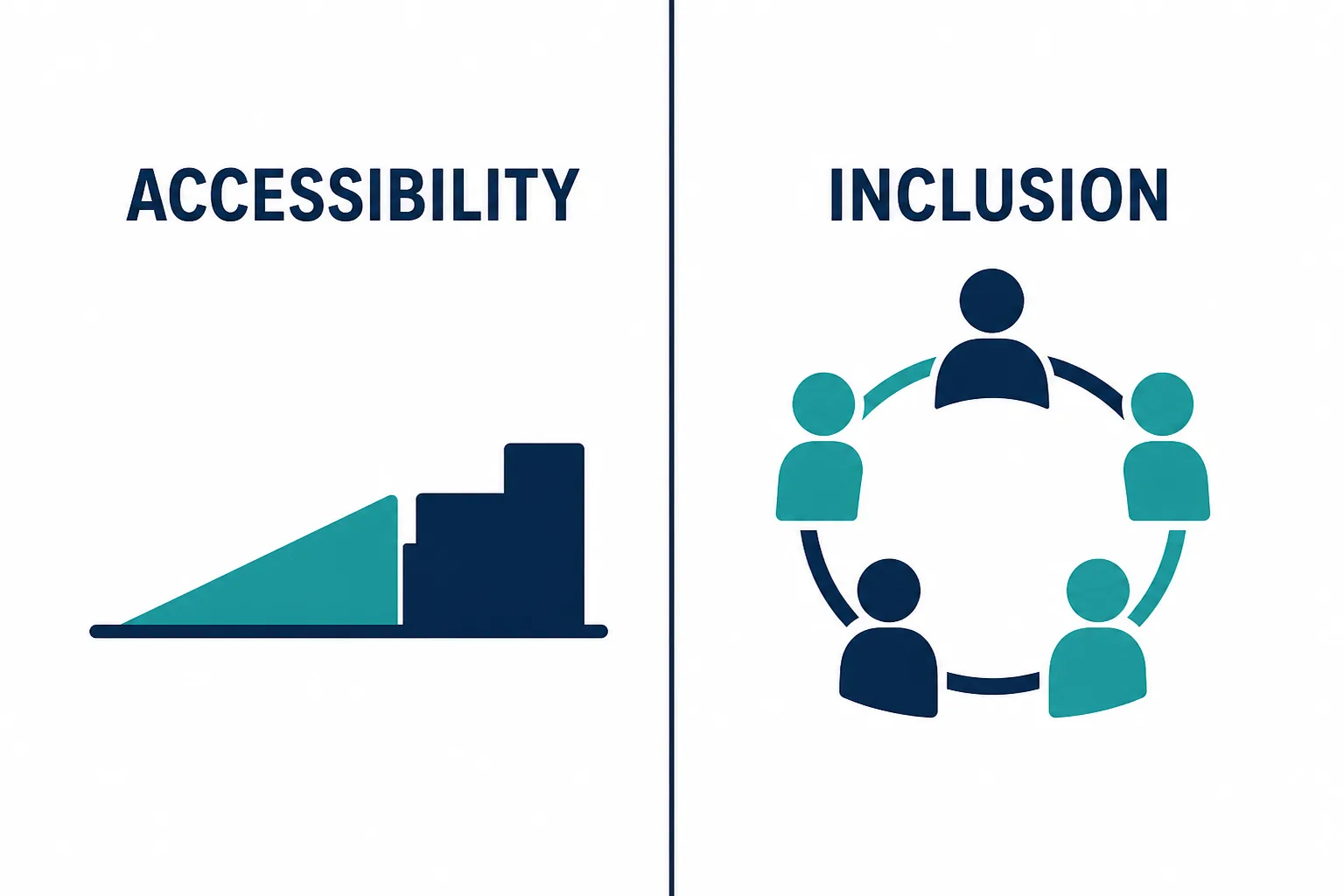
Disability inclusion is the practice of valuing employees with disabilities for their strengths and designing systems that work for everyone by default. It goes beyond meeting a legal minimum or filling a hiring quota. Two ideas often get blurred here. Accessibility is about removing barriers, such as a step-free entrance or a captioned video. Inclusion is broader: the sense of belonging and the real opportunity to contribute and advance once someone is in the room.
That sits inside the wider idea of diversity and inclusion, where diversity is the mix of people you employ and inclusion is whether all of them can participate fully. Disability is one dimension of that mix, alongside race, gender, age, and background. Practicing inclusion means treating accessibility as a standard feature of how you operate, not a favor granted on request.
Practicing inclusion means treating accessibility as a standard feature of how you operate, not a favor granted on request.
Why disability inclusion matters (the business and human case)
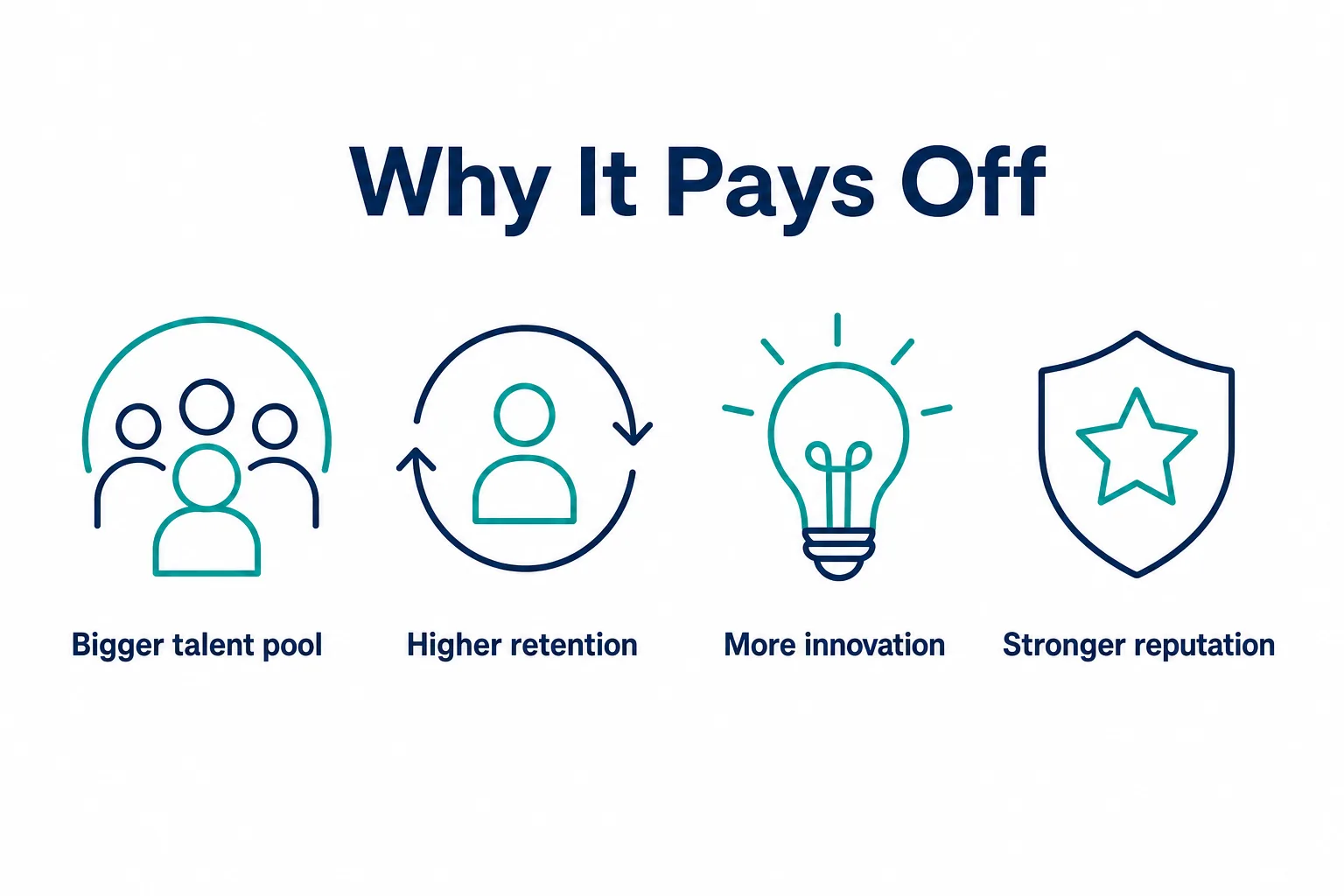
Inclusion widens the talent pool, strengthens retention, and brings problem-solving perspectives that homogeneous teams miss. People who navigate barriers others overlook often bring practical innovation and loyalty with them. Research on disability inclusion, firm performance, and reputation links inclusive practices to stronger business outcomes, and analysis from Michigan State University’s Broad College points to gains in productivity and engagement.
A common question is how diversity and inclusion pay off. In short: a larger and more skilled talent pool, higher retention and engagement, more innovation from varied perspectives, and a stronger reputation with customers and future hires. There is a human case too. Meaningful, fairly paid work is tied to dignity, financial security, and health. A review of the association between employment status and quality of life for people with disabilities connects workplace participation to improved well-being, one reason inclusion pays off well beyond the balance sheet.
How to improve disability inclusion in the workplace: 7 practical steps
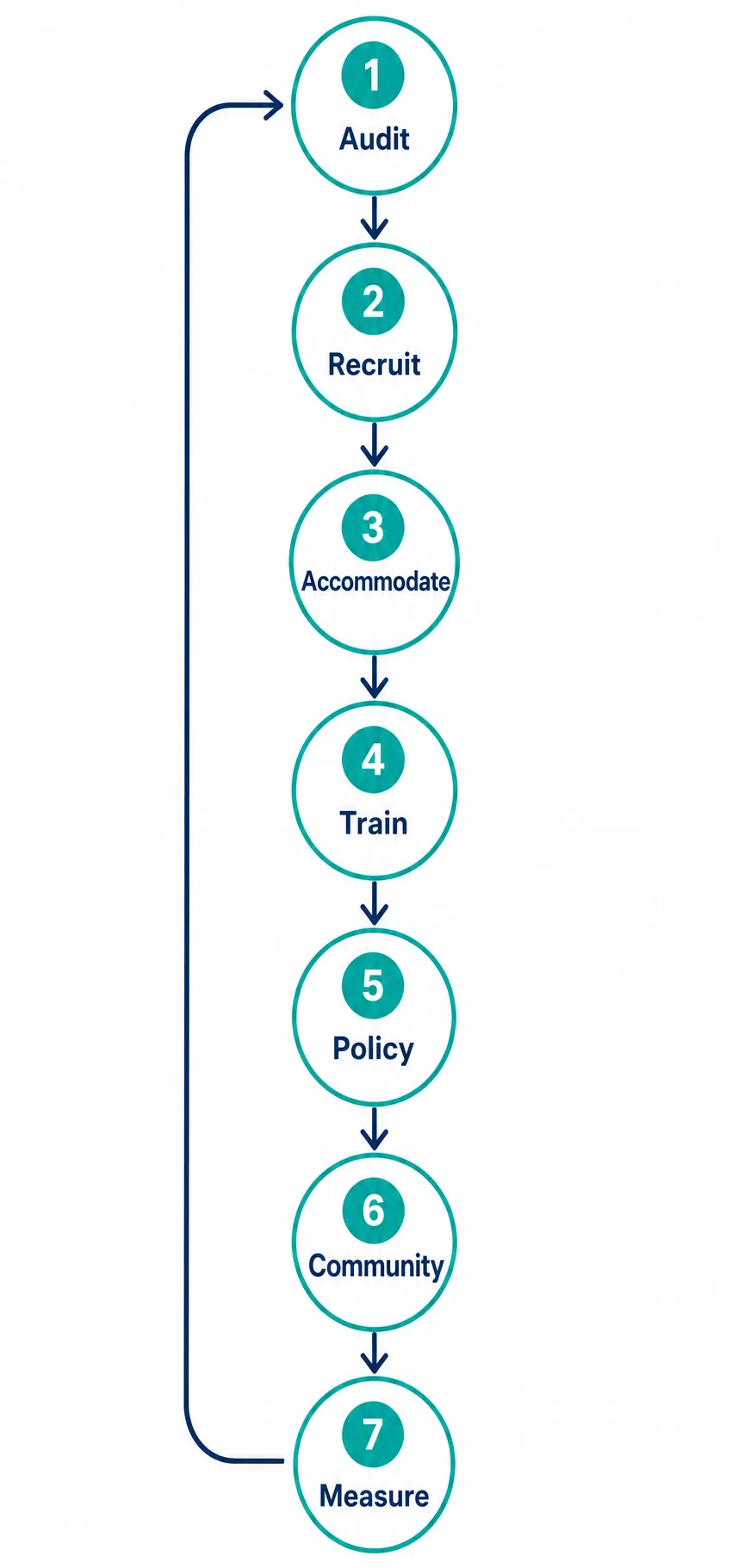
1. Audit your workplace through an accessibility lens
Review your policies, physical space, and digital tools. Can an employee easily request what they need? Is your website usable with a screen reader? The CDC’s disability inclusion strategies offer a useful framework for this kind of review. For a structured starting point, our resources for assessing current practices and drafting accessible frameworks can help you scope the work.
2. Build inclusive recruitment and hiring practices
Write job ads in plain language, list only the requirements the role genuinely needs, and make the application process usable with assistive technology. Offer flexible interview formats, such as questions in advance or a skills-based task, so candidates can show what they can do rather than how well they handle an artificial setting.
3. Make accommodations easy and normal
A good accommodation process is low-friction and predictable. Publish how to ask, respond quickly, and treat requests as routine rather than exceptional. Many accommodations cost little or nothing, and tax incentives can help offset the cost of those that do.
4. Offer disability awareness and allyship training
Turn captions on by default for meetings, share documents in accessible formats, and teach managers to model these habits. Encourage self-advocacy so employees feel safe naming what helps them work well.
5. Write inclusive policies and embed them
Culture is fragile when it lives only in individuals. Codify accessibility into written policy so it survives staff turnover and leadership changes. Our free toolkit for advancing disability-inclusive policy gives leaders a template for drafting frameworks that stick.
6. Support employee resource groups and community
Back disability-focused employee resource groups, involve their members in onboarding, host awareness events, and extend support to caregivers. Community turns policy into belonging.
7. Measure, listen, and improve
Track representation, gather feedback, and act on what you hear. Lessons drawn from decades of disability-employment research consistently show that sustained, measured effort, not one-off gestures, is what changes outcomes.
Disability inclusion in the workplace examples

Inclusion looks concrete in practice. A team that keeps captions on by default lets a hard-of-hearing colleague follow every meeting without asking. Flexible schedules let an employee manage medical appointments without penalty. Screen-reader-compatible software means a blind analyst can use the same tools as everyone else. A mentorship program helps employees with disabilities move into leadership rather than staying stuck at entry level. Accessible events, with quiet spaces and clear signage, signal that everyone is expected to attend. Each turns a potential barrier into an ordinary part of how the team works.
| Barrier type | How to overcome it |
|---|---|
| Attitudinal (assumptions about what someone can do) | Awareness training and direct contact |
| Physical | Accessible facilities and remote or hybrid options |
| Communication | Captions, transcripts, and multiple formats |
| Process (like a confusing accommodation request) | Simplify and publicize the steps |
How to overcome common disability inclusion barriers
Overcoming barriers starts with naming them. Attitudinal barriers, such as assumptions about what someone can do, are best countered with awareness training and direct contact. Physical barriers call for accessible facilities and remote or hybrid options. Communication barriers ease when you provide captions, transcripts, and multiple formats. Process barriers, like a confusing accommodation request, shrink when you simplify and publicize the steps. The pattern is the same each time: identify the obstacle, then redesign the system rather than asking the person to work around it.
Frequently asked questions
How do you overcome disability barriers?
What makes diversity and inclusion valuable for workplaces?
Why is disability inclusion important?
How can disability inclusion improve quality of life for people with disabilities?
Moving from intention to action
Inclusion is not declared, it is built: through the audit you run this quarter, the policy you write, the meeting you caption. Pick one step above and start there, then measure and expand. To see how this work connects to a broader mission, explore our approach to global leadership in disability inclusion, and treat inclusion as a practice you refine over time rather than a box you check once.