
Plenty of disability awareness sessions get scheduled, delivered, and then quietly forgotten. Everyone nods along, the slides get filed away, and workplace habits stay exactly where they were. If you have been asked to run a disability awareness training session, your real job is not to fill an hour. It is to shift how people think and, more importantly, how they behave the next time a colleague or customer with a disability walks in. Training sticks best inside a wider effort, so consider how to start a disability inclusion program around it.
This is a facilitator’s playbook. It covers what to prepare, how to structure the agenda minute by minute, what content actually lands, how to adapt for online delivery, and how to tell whether any of it worked. Hand participants a disability inclusion checklist for employers so the session ends with concrete next actions. A strong session pairs a genuine mindset shift with concrete etiquette and practical workplace habits, and that combination is what the rest of this guide is built around.
What “disability awareness training” actually means (and what it isn’t)
Disability awareness training, discussed in reviews of the Americans with Disabilities Act at 30, is structured learning that builds understanding of disability, reduces bias, and teaches inclusive behavior and etiquette. That is the whole meaning of it: knowledge plus attitude plus practical know-how, delivered so that people leave more comfortable and more capable around disability than when they arrived. According to work on Motivational Interviewing in Vocational Rehabilitation, and the Colorado Division of Vocational Rehabilitation’s overview of ADA disability awareness training, the aim is to help staff understand disability, recognize barriers, and interact respectfully, rather than to memorize legal clauses.
It helps to name what awareness training is not. It is not compliance training, which focuses on the legal requirements of the Americans with Disabilities Act and your obligations as an employer. It is not full inclusion training either, which digs into systems: accommodation processes, accessible procurement, hiring pipelines, and policy. Awareness is the foundation the other two build on. Run it as if it were a legal briefing and you will lose the room; run it as if it solves everything and you will overpromise.
Awareness vs. etiquette vs. inclusion training
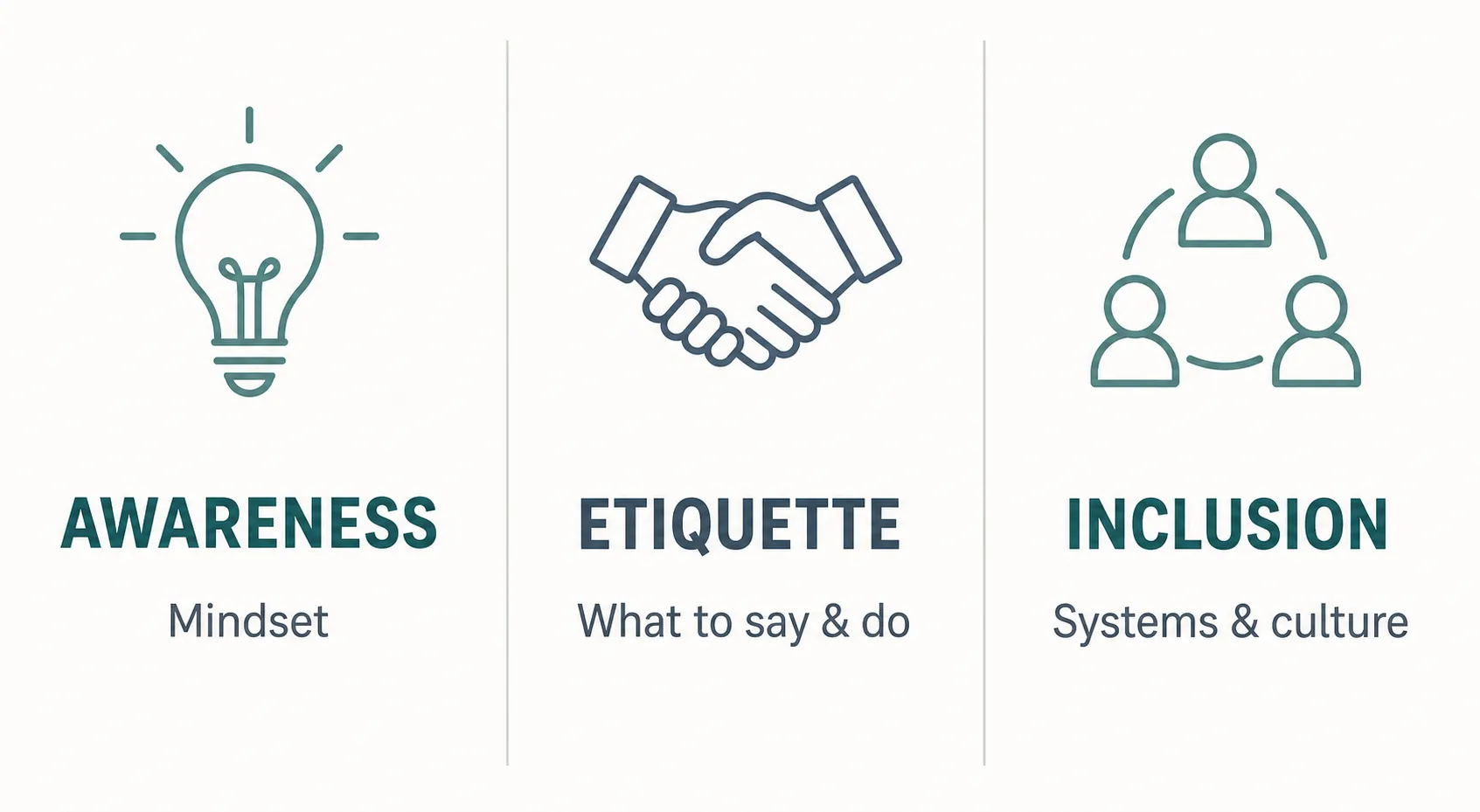
Three terms get used interchangeably, and scoping your session correctly means knowing the difference:
| Type of training | What it covers |
|---|---|
| Disability awareness | Builds understanding and challenges assumptions. It is the mindset layer. |
| Disability awareness and etiquette | Adds the practical “what do I actually do or say” layer: how to offer help, what language to use, how to interact respectfully. |
| Disability awareness and inclusion | Goes further into workplace systems, accommodations, and sustained cultural change. |
Most single sessions blend the first two. If leadership wants systemic change, be clear that one workshop is a starting point, not the finish line.
Before you run the session: a planning checklist
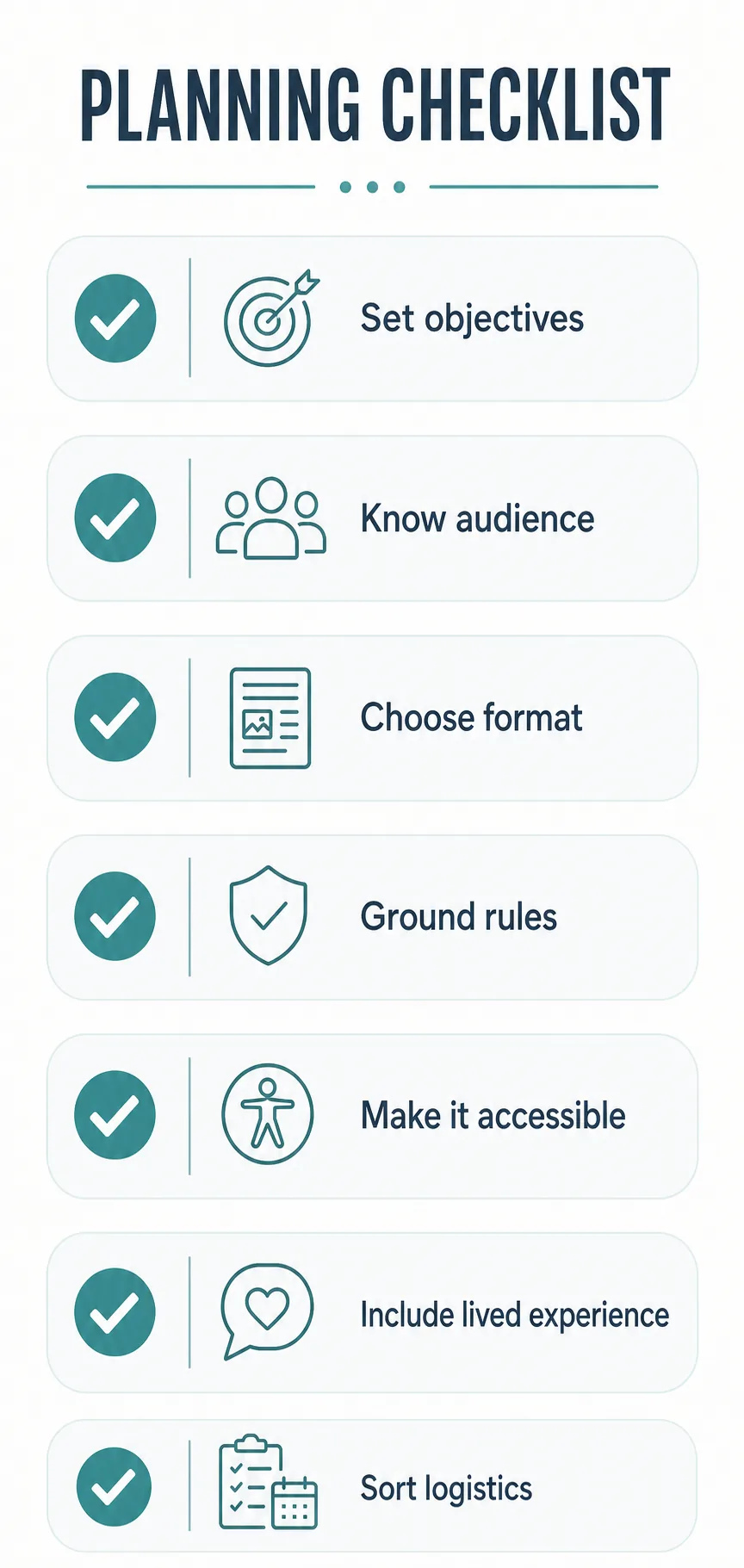
The prep decides whether the session lands. Here is a genuine disability awareness checklist you can work through before anyone shows up:
- Define two or three measurable objectives. Not “raise awareness,” but “participants can name three inclusive-language practices and describe our accommodation request process.”
- Know your audience. All-staff, managers, or customer-facing teams need different emphasis and different examples.
- Decide the format: in person, online, or hybrid. Each changes your logistics and your activities.
- Set ground rules for respectful discussion, so people can ask honest questions without fear of saying the wrong thing.
- Make the training itself accessible. Captions, screen-reader-friendly slides, alt text on images, a physically accessible room, and materials sent in advance. A session about inclusion that excludes people is a bad look and a wasted opportunity.
- Involve people with lived experience. Co-facilitation with disabled speakers makes the content authentic. Pay them fairly and never treat them as a token or a prop.
- Sort the logistics: time of day, session length, and group size that allows real discussion.
The University of Wisconsin–Madison Extension’s disability awareness curriculum for adults is a useful model for turning objectives into structured activities rather than a one-directional lecture.
Setting learning outcomes that matter
Push past feel-good outcomes toward behavior-change ones. “Attendees felt more empathetic” is nice but unmeasurable. “Attendees can demonstrate offering assistance the right way” or “managers can explain how to handle an accommodation request” gives you something to observe and follow up on. Write outcomes as things people will do differently on Monday, and design every block to serve at least one of them.
Write outcomes as things people will do differently on Monday, and design every block to serve at least one of them.
How to structure the session: a step-by-step run of show
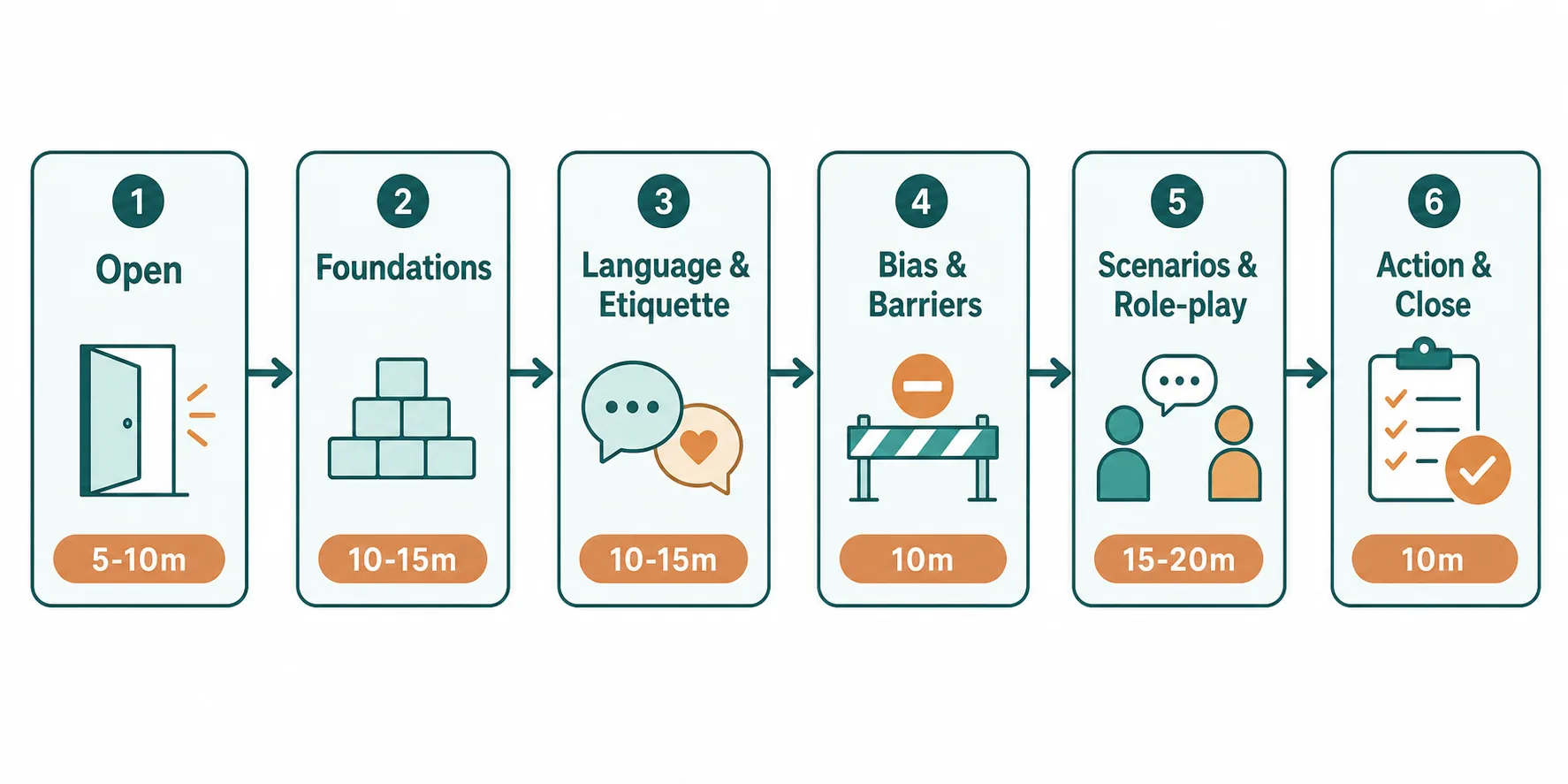
Here is a sample 60 to 90 minute agenda you could run as-is. Adjust the time blocks to your group.
| Block | Time | What to cover |
|---|---|---|
| Open | 5–10 min | Set ground rules and explain why the session exists. Connect it to real situations your team encounters. |
| Foundations: the diversity of disability | 10–15 min | Cover the range: physical, sensory, cognitive, and mental health conditions, plus neurodivergence. Emphasize that many disabilities are invisible and that disability is a normal part of human variation, not a rare exception. |
| Language and etiquette | 10–15 min | Person-first versus identity-first language, how to offer help, and how to interact respectfully. This is where abstract goodwill becomes usable skill. |
| Bias and barriers | 10 min | Attitudinal, environmental, and systemic barriers, including the biases that show up in hiring and advancement. Help people see that the “problem” is usually the environment, not the person. |
| Scenarios and role-play | 15–20 min | Work through realistic situations. This is the part that drives retention, so protect the time for it. |
| Action and close | 10 min | Individual commitments, a walk-through of your accommodation process, and where to go next. |
Teaching disability awareness well means less lecturing and more doing. The blocks above move from knowledge to practice on purpose.
Etiquette essentials to cover
Give people concrete do’s they can remember under pressure:
- Ask before helping, and accept “no thanks” gracefully.
- Speak directly to the person, not to their interpreter, aide, or companion.
- Offer a handshake or your usual greeting; let the other person adapt it if they need to.
- Never touch, move, or lean on a wheelchair or mobility aid; it is part of someone’s personal space.
- Respect privacy around disclosure. It is not your news to share.
These small behaviors are what colleagues and customers actually notice.
Activities that make it stick (beyond slides)
Discussion prompts, real workplace scenarios, and panels with disabled colleagues outperform any deck. But choose activities carefully. Avoid disability simulations such as blindfolding people or putting them in a wheelchair for an hour. Research on the design and effect of awareness training shows the outcomes vary and depend heavily on how the training is built; a 2025 study examining a one-week disability awareness program illustrates that awareness activities do not automatically translate into lasting attitude change. Simulations in particular tend to leave participants with pity and discomfort rather than understanding, because a few minutes of “trying on” a disability captures the difficulty without the adaptation, skill, and normal life that come with it. Lived-experience storytelling does the job far better.
How to run a disability awareness training session online
Virtual delivery works well when you plan for it. To run a disability awareness training session online:
- Turn on live captions and confirm your platform is screen-reader compatible.
- Set camera and mic norms up front, and make clear that cameras-off is fine. Not everyone can or wants to be on screen.
- Use breakout rooms for scenario work so people still practice, not just listen.
- Shorten the blocks and add breaks. Screen fatigue is real, so two shorter sessions often beat one long one.
- Treat the chat as an inclusion tool. It lets people who find speaking up hard still contribute, and it gives you a record of questions.
- Send materials ahead of time so participants can review slides with their own assistive technology at their own pace.
The core content stays the same; you are adapting the delivery so no one is left out by the medium.
Disability awareness training in the workplace: tailoring by audience
Generic training is forgettable training. Tailor the emphasis to who is in the room.
For all employees
Focus on everyday interaction: language, etiquette, recognizing barriers, and knowing how to be a good colleague. Keep it practical and rooted in situations they actually face, whether that is a teammate who discloses a condition or a customer who needs a different kind of support.
For managers and employers
Disability training for employers needs a sharper edge. Managers set the tone, so cover the biases that creep into hiring and promotion, how to handle accommodation requests without awkwardness, and how inclusive practices support retention. Make the inclusion case honestly: hiring and keeping disabled employees widens your talent pool and strengthens the team. Frame this as facilitation content, not a recruitment pitch, and managers will trust it.
How to measure success and keep momentum
Most training ends at delivery. That is exactly why most training fails to change anything. Measurement and follow-through are where awareness turns into culture.
- Run a short pre and post survey to capture shifts in confidence and knowledge.
- Watch for behavior indicators over the following weeks: are accommodation requests handled more smoothly, is inclusive language becoming normal, are people speaking up?
- Schedule follow-up. A single session fades; a series or periodic refreshers builds habit.
- Tie awareness into everyday policy so it lives in your processes, not just one afternoon.
Promoting disability awareness at work is a year-round effort, not a one-off. Support employee resource groups, mark Disability Awareness Month and other relevant observances with substance rather than a token social post, and keep offering ongoing disability training so new hires and refreshed teams stay on the same page.
Awareness that only appears once a year reads as performance; awareness woven into the calendar reads as commitment.
Common mistakes that make awareness training fail
Awareness training gets a bad reputation when it is run badly. The usual failure modes are avoidable:
- One-and-done sessions with no reinforcement. People forget, and behavior snaps back.
- Disability simulations that generate pity instead of understanding.
- Tokenism, whether that is featuring disabled colleagues without paying or crediting them, or launching an initiative for optics.
- No follow-through. No measurement, no policy change, no next step.
- Box-checking to satisfy a requirement, which participants can always smell.
- Ignoring the accessibility of the training itself, which undercuts the entire message.
Name these openly in your own planning. A session that dodges every trap on this list is already ahead of most.
Frequently asked questions
How do you teach disability awareness?
What should be on a disability awareness checklist?
How can I promote disability awareness at work year-round?
What’s the difference between disability awareness and disability etiquette training?
How long should a session be?
A training session is a starting point, not a finish line. The goal is not a completed calendar invite; it is durable, inclusive behavior that shows up long after the slides are closed. Run it with real preparation, honest content, and genuine follow-through, and you move your workplace closer to the kind of everyday inclusion that lasts.